


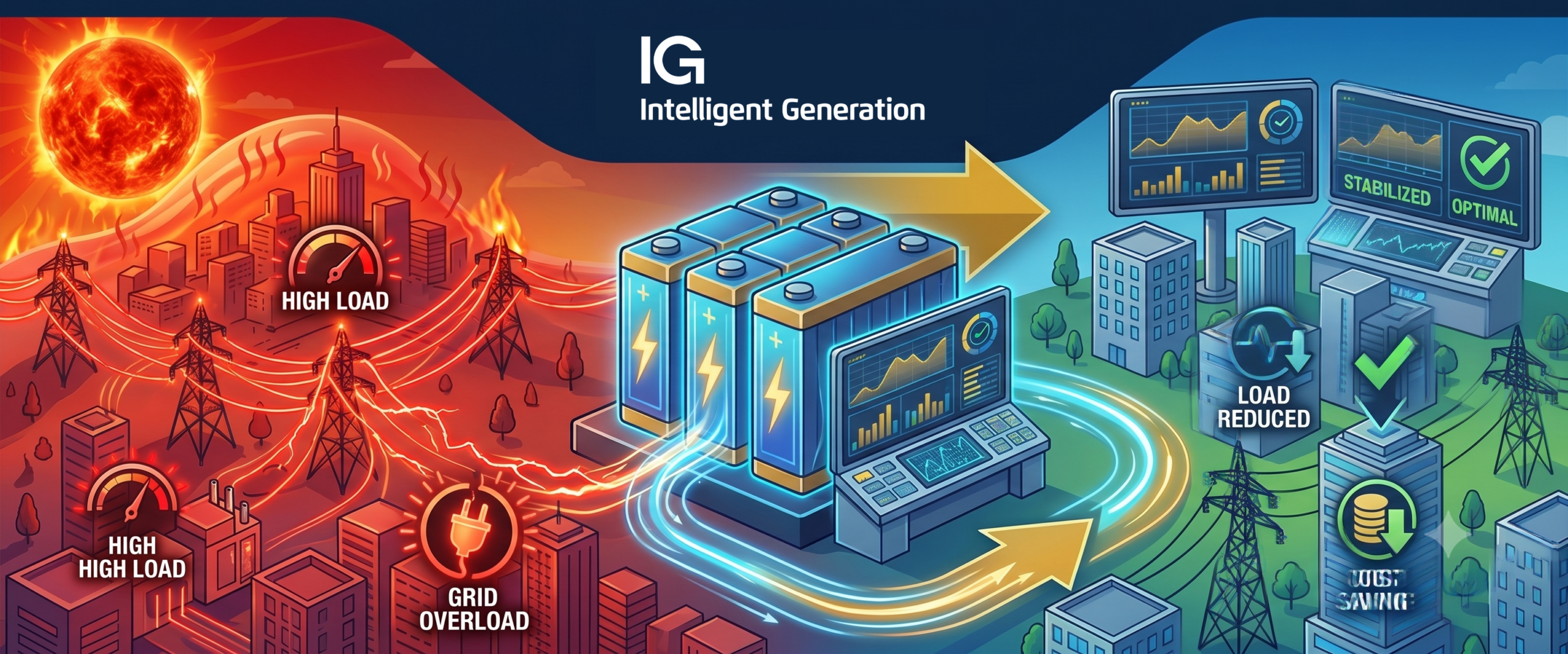
Last week, the power grid experienced a trial by fire. A relentless, sweltering heat wave parked over the entire PJM Interconnection footprint from June 29 to July 2, pushing our energy infrastructure to its absolute limits. From Illinois all the way to the Atlantic coast, the grid was tested like never before.
The U.S. Department of Energy (DOE) enacted emergency orders, and operators at PJM—the largest regional transmission organization in the country, serving 67 million people—issued critical Maximum Generation and Load Management alerts. Power demand across the PJM territory was forecasted to reach a staggering 166,147 MW, threatening to shatter a 20-year-old all-time summer peak record.
While operators were scrambling to manage grid stress across 13 states, Intelligent Generation’s (IG) POWR:Suite software was doing exactly what it was built to do: predicting the chaos, protecting our customers, and stabilizing the PJM grid.
Here is how our managed fleet of Battery Energy Storage Systems (BESS) stepped up when the PJM network needed it most.
Anticipating the Surge: Precision Forecasting
You can’t manage a crisis if you don’t see it coming. At Intelligent Generation, our technology does not merely react to the market; it anticipates it. Our sophisticated algorithms ingest massive data sets—historical load demands, real-time weather patterns, and shifting market dynamics across PJM—to predict exactly when the grid will peak.
Leading up to July 1 and 2, our models accurately flagged these specific hot afternoons as highly probable Coincident Peak (CP) events. In the PJM market, a commercial customer’s capacity and transmission charges for the entire following year are heavily determined by their energy usage during these grid peaks. While the five highest overall peak hours of the summer (known as the 5CP) dictate capacity costs, the absolute highest peak hour for a utility zone dictates a facility’s transmission charges.
Using large amounts of power during these hours costs businesses millions. Predicting them perfectly and discharging batteries during those hours saves millions. Our software locked onto these critical windows, preparing our battery fleet for optimal dispatch.
Dispatching the Fleet: Relief for Customers and the Grid
When millions of air conditioners kicked into overdrive and PJM’s operating reserves dwindled, IG executed a perfectly timed dispatch. We seamlessly transitioned our customers’ facilities from pulling grid power to running entirely on stored battery power.
This automated dispatch delivered a multi-tiered victory:
- Slashed Next Year’s Capacity and Transmission Costs: By drastically reducing our customers’ load during these crucial PJM peak hours, we effectively minimized their Peak Load Contribution (PLC) for capacity and their Network Service Peak Load (NSPL) for transmission. This strategic move guarantees that our clients will see massive reductions in both their capacity and transmission charges for the 2027 planning year.
- Shielded from Volatile Energy Pricing: As capacity shrank, PJM real-time locational marginal pricing (LMP) spiked. Our batteries allowed customers to shield themselves from these exorbitant real-time costs, running on clean energy that was stored when prices and demand were low.
- Critical Grid Relief: Every megawatt of behind-the-meter battery power we deployed was a megawatt PJM didn’t have to scramble to generate or push through congested transmission lines. By reducing aggregate demand during the absolute peak, IG’s fleet suppressed the overall load, directly aiding PJM operators in maintaining system stability and avoiding emergency voltage reductions. In effect, our customers provided their own generation capacity during these peak hours while also providing relief to the transmission and distribution grids.
The Intelligent Answer to a Volatile Future
Last week was a stark reminder of our new reality. Extreme weather is becoming the norm, and an aging grid—now heavily burdened by the massive energy demands of booming AI data centers and manufacturing—is increasingly vulnerable across the entire PJM footprint. Building more fossil-fuel peaker plants is a slow, expensive, and environmentally damaging band-aid.
The true, scalable solution lies in Intelligent Generation. By coordinating and optimizing a network of distributed energy assets, we transform passive batteries into dynamic, revenue-generating powerhouses. We don’t just protect commercial and industrial businesses from the financial volatility of the energy market; we empower them to engage the clean energy grid.
The historic peaks of July 2026 proved a simple truth: when PJM is pushed to the limit, intelligent software ensures your energy assets are at their best.